The Quiet Shift: How AI Is Redesigning the Way We Work
This is about the foundational problems of AI and Machine Learning.
There is a moment every few decades when technology stops being a tool you pick up and becomes the environment you work inside. Electricity did it. The internet did it. Now, artificial intelligence is doing it — quietly, at scale, in the background of thousands of professions at once.
I started this blog because I want to think clearly about that shift. Not to hype it, not to fear it — but to understand what it actually changes for the people doing the work.
What's actually happening
The popular narrative is all about replacement. AI will take your job. Your skills will be obsolete. Retrain or fall behind. It makes for good headlines, but it misses something more nuanced and more interesting.
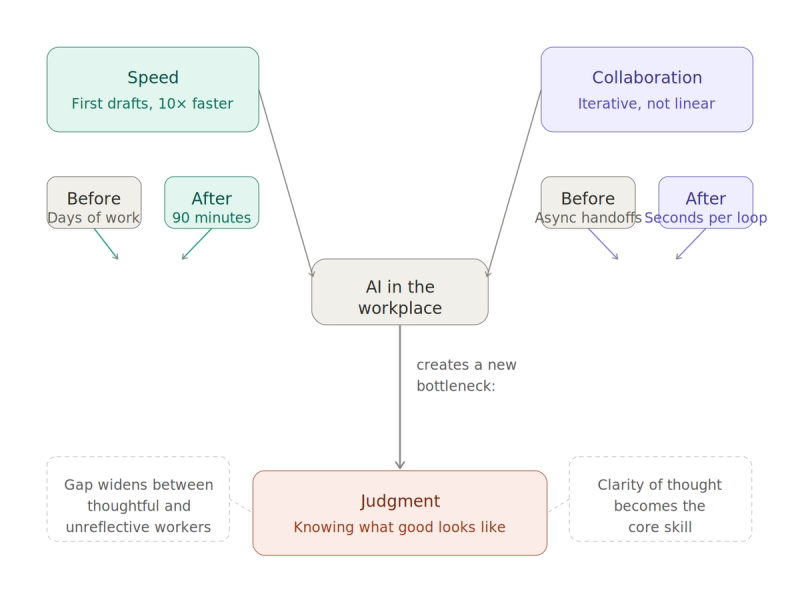
What AI is doing, in most knowledge work today, is compressing the cost of the first draft. Writing, researching, summarizing, coding, generating ideas — these tasks used to consume a significant portion of a professional's day. They still happen. But they happen faster. What that creates is not unemployment. It creates a new bottleneck: judgment.
The most valuable skill right now is not prompt engineering. It is knowing what good looks like.
When a junior analyst can produce a solid research brief in ninety minutes instead of two days, the question shifts from "can you do the work?" to "can you tell when the work is actually good?" AI amplifies output. It does not — yet — reliably amplify discernment.
Three shifts worth paying attention to
Speed is the obvious one. First drafts across most writing tasks are now dramatically faster — what took a full day can take under two hours. But the second shift is subtler: the nature of collaboration is changing. Working with AI is iterative in a way that working with a colleague is not. You get a result in seconds. You refine, redirect, question. The skill is learning to be a good creative director of a very fast, very literal assistant.
The third shift is harder to measure but probably the most consequential: AI is making the gap between a thoughtful person and an unreflective one much larger. If you know what you want and can articulate it precisely, these tools are extraordinarily powerful. If you do not, you get a lot of confident-sounding noise.
What this blog is for
I am not an AI researcher. I am someone who works with technology every day and thinks a lot about how to do it well. This blog is a record of that thinking — practical, honest, and as jargon-free as I can manage.
In future posts I want to explore specific workflows, specific tools, and specific moments where AI genuinely changes what is possible for individuals and teams. I will try to write about what works and also about what does not — which may be more useful.
If you are navigating the same questions, welcome. I am glad you are here.
Sheersho Pramanik
Dev
Enjoyed this?
Subscribe to get new essays delivered to your inbox.